

Election year survey recognises franchise concerns
Earlier this year, Franchise Association of New Zealand (FANZ) members were invited to participate in the 2026 Deloitte and Chapman Tripp Election Survey, providing a unique franchise perspective within an influential business survey normally dominated by larger firms
A triennial BusinessNZ member survey undertaken in each election year by Deloitte and Chapman Tripp was extended in 2026 to include FANZ members too, with the Franchise Association now a member of BusinessNZ’s Affiliated Industries Group. The full survey is weighted more towards larger businesses (over a quarter of respondents reportedly employing 500 or more staff). It is interesting to see the different viewpoint offered by the subset of FANZ respondents, although only a few questions have been segregated for this analysis, due to the complexity and scale of the survey.
In the full survey, each major political party is also asked for their policies surrounding some of the key areas surveyed. You can read the published results at https://businessnz.org.nz/wp-content/uploads/2026/09/businessnz-2026-election-survey.pdf
Katrina King, CEO of FANZ, said, “Overall, FANZ respondents appear focused on creating a more enabling business environment through simpler regulation, lower compliance costs and stronger economic conditions.
“While workforce capability remains important, skills shortages are not currently viewed as a critical constraint for most businesses. Members are generally supportive of proposed reforms to the Holidays Act and Health and Safety legislation, particularly where these reduce complexity and provide greater certainty.
“Looking ahead, FANZ respondents see economic growth, business confidence, workforce skills development and the impact of emerging technologies as the key issues that will shape and drive the future success of New Zealand franchise businesses.”
Regulatory reform
Over one third of both FANZ member respondents and other BusinessNZ respondents were in agreement that recent regulatory reforms have improved the productivity and ease of doing business in New Zealand to some extent, with just over another third believing these reforms have made no material difference.
For FANZ members in particular, the four aspects of regulation considered to have the greatest impact on their businesses are as follows.
- The complexity or inconsistency of regulations
- Regulatory compliance costs
- Length of approval or consenting processes
- Frequency of regulatory change
"It’s interesting to see that complexity and inconsistency of regulation are the top concern for our members,” Katrina said. “One of the real strengths of FANZ is the expertise within our Advocacy and Regulatory Committee, which keeps members informed of relevant regulatory developments and helps them understand what those changes mean for their businesses.”
Future growth
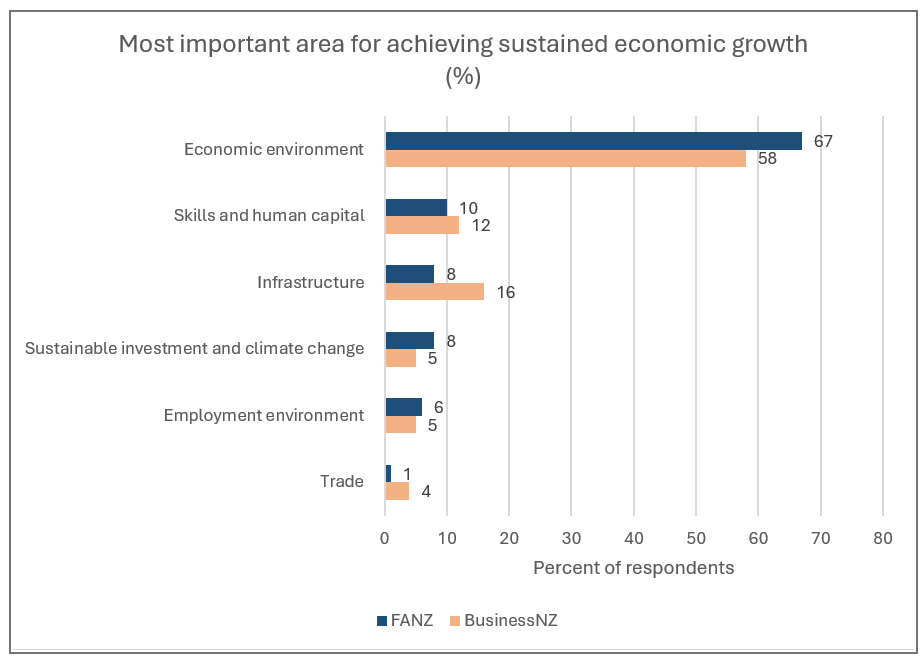
The wider group of BusinessNZ firms represented in the survey appear less concerned about the impact of the Economic environment in sustaining future growth than FANZ member respondents, although it was still the number one concern for both. FANZ members highly rated access to Skills and human capital, the Employment environment and Sustainable investment and climate change, while Infrastructure was a more significant concern for the larger firms.
Immigration and Employment
Over half of the FANZ member respondents said that they do not use immigration (presumably either for employment or franchisee recruitment purposes), but of those who do, around half had found it harder to access international skills under the new Accredited Employer Assisted Visa system.
When asked, “Do you have confidence in getting the skills needed for your business under current immigration settings?” only 43% of FANZ member respondents replied yes, compared to 53.5% of the BusinessNZ respondents. 28% of FANZ member respondents were unsure, compared to 21% of BusinessNZ respondents.
FANZ members were also far more uncertain about the likely impacts on the size and composition of their workforce due to emerging technologies such as AI and robotics – not surprising given the much smaller workforces in franchise businesses.
Almost half of the FANZ member respondents considered that the current skills shortage in New Zealand is not constraining their business’s ability to improve productivity and adopt new technology.
With an eye to the future, however, franchisors consider that the Government’s top educational priorities should be focused on increasing the literacy, numeracy and basic skills of the workforce and incentivising businesses to take on apprentices and/or provide more training.
51% of FANZ member respondents were prepared to pay the living wage as a minimum in their businesses – although it is worth noting that this of course represents the franchisor perspective, not necessarily the franchisee perspective on this matter.
Both BusinessNZ and FANZ member respondents were in accord that the proposed reform of the Holidays Act will have either a net positive impact or no material impact on their businesses, with fewer FANZ members concerned about a net negative impact.
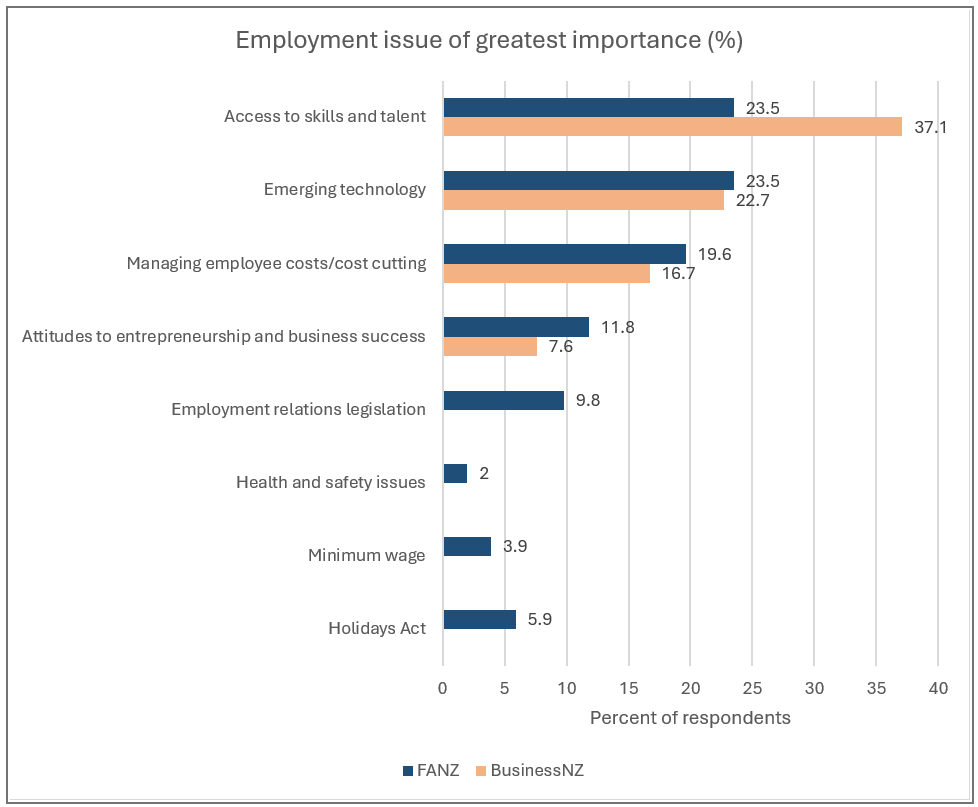
Comparing both sets of responses about the employment issues of greatest importance, access to skills and talent is a much stronger concern for franchises than it was for the BusinessNZ respondents. This result may include franchisors’ number one priority to find and recruit good franchisees, as well as their concerns about their own and their franchisees’ access to quality employees.
“We’re very pleased to have FANZ take part in this survey for the first time, and to have had such good engagement from our members sharing their thoughts on the key issues affecting the success of their businesses,” Katrina said.
“Franchising represents around 30,000 small to medium business owners in New Zealand, so its impact on the results of the general election is not inconsiderable.”
How might any of this impact the general election?
A new MYOB survey of more than 500 small and medium-sized enterprise (SME) owners and decision-makers has found a close split between SME supporters of the combined right-bloc parties (49%) and combined left-bloc parties (40%) – assuming that any coalition option includes the Opportunity party.
The survey was conducted in late August to early September, with results published in October, so much could have changed again in the interim, but MYOB’s CEO Paul Robson said that more than a third of respondents thought their party vote this election was likely to differ from their vote in 2023.
Time will tell...
last updated 07/10/2026
last updated 07/10/2026
Featured Listings
Goodwin Turner Commercial Lawyers
Goodwin Turner Commercial Lawyers aims to provide a modern, friendly, client-focused and efficient approach to your legal business requirements, with a...

Speed Queen Laundry Systems
Enjoy semi‑passive income with your own Speed Queen self‑serve laundromat. With our expert support you’ll be operating a profitable business in no time,...

CrestClean
Looking for a simple business with low risk and high profit margins - where you can enjoy a great lifestyle? A CrestClean franchise ticks all the boxes!...

Westpac New Zealand
Westpac is New Zealand's most experienced bank in franchising and the only bank offering dedicated franchise specialist managers throughout the country....

