
WORKING CAPITAL - fuel in the tank
Franchise Accountants explain what you need to get your business started and keep it going
A lack of working capital is the most common reason that businesses fail. Buying a franchise and trying to run it without sufficient working capital is like going on a road trip without enough fuel to reach the next petrol station.
What is working capital?
Franchise Accountants explains that after the initial investment required to get into a franchised business, you’ll need more money to run the business. Working capital is the money that you need on a day-to-day basis to buy supplies or stock, pay your power bill, meet staff wages and all the other things that a business has to do.
When you first open your doors, you are likely to have more money going out than coming in, so you need enough funds available to make up the difference. As your business grows, more money should be coming in than going out but you may still need working capital to buy more supplies or stock. Plan ahead to introduce more cash to the business by using profits generated, borrowing more, or releasing funds locked up in the trading cycle.
How much do you need?
The amount you need depends on various factors. Is your business premises-based or mobile? Do you mainly make cash sales, or give customers time to pay? Is it a start-up or have you taken over an existing business?
In a typical food and beverage business, customers pay on the spot, whereas the wages and suppliers are usually paid weekly. This type of business is often called a cash business, which is defined as having no debtors (customers who pay on credit terms) and little or no stock.
Contrast this to a service business such as building, which pays its workers weekly while providing credit to customers who may take weeks to pay. Or a retail business, which holds stock on shelves, pays rent and wages, yet its customers pay on invoice.
How does it work?
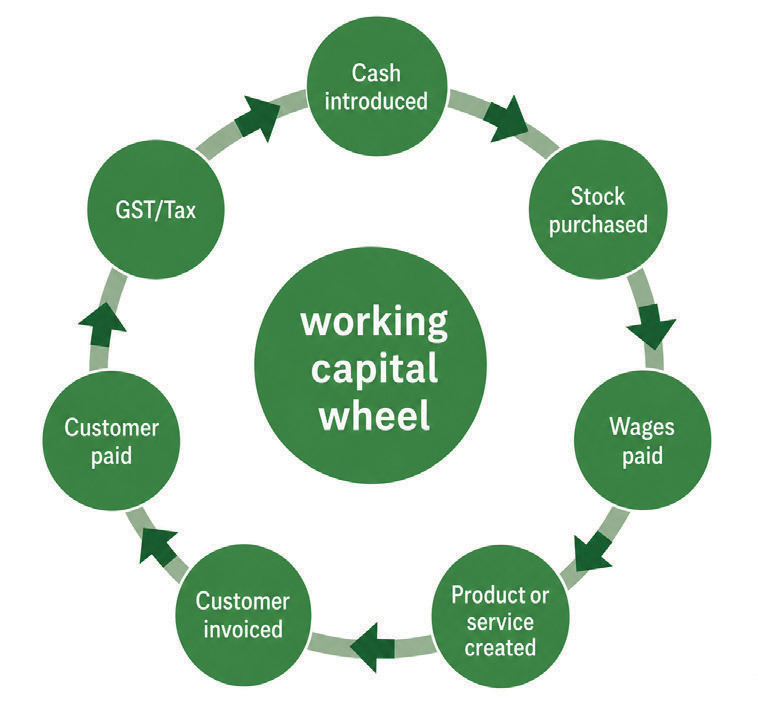
The diagram above shows how the cash outlaid to deliver a product or service is finally recovered. The amount of time it takes to complete the cycle will vary. But whether it’s 20 days or 90 days, the principle is the same.
Cash introduced at the start of the cycle is the working capital. Cash is replenished at the end of the trading cycle, when the product or service is paid for.
Stock purchased - To make sales, you need something to sell. Stock needs to be purchased, and suppliers paid, often before you start to trade. Consider lead times for restocking and minimum buying quantities. Over stocking or slow-moving stock lines can lock up cash and impact working capital requirements.
Wages paid - Staffing levels vary enormously, and you need to pay everyone on time, every time.
Product or service created - Capital required varies according to each business. With product businesses, you need stock or ingredients. For service businesses, you may hold basic parts, pay maintenance costs etc.
Customer invoiced - Do customers pay on the spot or monthly? In tighter economic times, slow paying customers can put pressure on working capital of a business, and this can have a domino effect.
Customer pays - Remember, it’s not until money has come in from customers that you have the cash to fund the next cycle. Profit is not the same thing as cashflow. Even a profitable business can fail if there is insufficient cash to fund its growth.
GST/Tax – If the timing is not right between when customers pay you and when you pay your GST and taxes, that can also put pressure on the working capital of your business.
Each business has its own cashflow dynamics. Get a cashflow forecast to assess your working capital requirements and take professional advice to help gain the insights you need to operate your business. At the end of the day, it is up to you to make sure you have enough fuel in the tank to complete your journey to business success.
See this advertorial on page 53 of Franchise New Zealand magazine Year 35 Issue 03
For more information and advice on buying a franchise get your FREE copy of Franchise New Zealand magazine.
Article by Franchise Accountants
last updated 15/09/2026
Article by Franchise Accountants
last updated 15/09/2026


Get in touch:
 Contact: Philip Morrison & Hayden Cargo
 FANZ Member: Yes
Area serviced: National
Listing information is supplied by that particular entity. You are advised to confirm the accuracy of the listing and the FANZ membership status of any entity. Neither the sponsors of this Directory nor FANZ nor the publisher accept responsibility for any omissions or errors.
Featured Listings
CrestClean
Looking for a simple business with low risk and high profit margins - where you can enjoy a great lifestyle? A CrestClean franchise ticks all the boxes!...

Westpac New Zealand
Westpac is New Zealand's most experienced bank in franchising and the only bank offering dedicated franchise specialist managers throughout the country....

Goodwin Turner Commercial Lawyers
Goodwin Turner Commercial Lawyers aims to provide a modern, friendly, client-focused and efficient approach to your legal business requirements, with a...

Speed Queen Laundry Systems
Enjoy semi‑passive income with your own Speed Queen self‑serve laundromat. With our expert support you’ll be operating a profitable business in no time,...

